
Hosts Extension Development: From Start to Finish
What is hosts
According to Wikipedia, hosts is a system file used by the operating system to map host names to ip addresses. It is a plain text file. We won't go into detail about IP and DNS here.
Business Scenario
In real-world development, a feature typically goes through functional testing across different environments: development -> testing -> staging -> production. In most cases, the development, testing, and staging environments are not publicly accessible. When a domain name cannot be correctly resolved by the DNS server, the page will fail to load. A common workaround is to configure the system-level host file, manually adding DNS cache entries so the browser can correctly resolve domain names and access the corresponding IP addresses.
However, some business domains share the same domain name across all environments and can only be distinguished by IP address. In that case, our host file would look like the following, and we'd switch environments by commenting/uncommenting the corresponding host entries. This invisibly adds a lot of repetitive work and may lead to inaccurate test results due to missed host entries, ultimately affecting business progress.
# Staging
172.127.80.1 common-url.com
# Testing
172.127.230.16 common-url.com
Don't Repeat Yourself is an important principle in software development, and it absolutely applies to daily work as well. Repeatedly modifying host files is neither elegant nor sustainable. Automation, or at least visualization, is urgently needed.
Solutions
There are two main approaches:
- Automated scripts to modify the system host file
- Browser extensions to redirect browser requests
Automated Scripts
We won't go into detail about automated scripts here. The general idea is:
- Create separate host files like
env1.txt,env2.txtfor different environments - Create an automation script that modifies the system host file with administrator privileges, controlling host clearing and writing through a single command
You could even create a dedicated application for dynamic host switching, such as SwitchHosts.
The advantage of this approach is convenience and speed. It can globally manage hosts.
The downside is that modifying the hosts file requires system administrator privileges. In some scenarios, if the user cannot obtain admin privileges, they won't be able to modify hosts.
Browser Extension Development
The idea behind browser extension development is straightforward. Through the API provided by Chrome.proxy, we can use PacScript in mode=pac_script mode to proxy hosts.
Moreover, due to the nature of extension development (it's basically a feature-rich web page), extensions can achieve better visualization compared to automated scripts.
Prerequisites
Browser extensions can achieve different effects through various file and feature configurations, but they typically consist of the following components:
- The manifest
manifest.json is a required file for any extension system and must be located in the extension's root directory. This file defines metadata, resources, permissions, background files, and other information.
- The service worker
The extension's service worker can listen to browser events, such as navigation, bookmark changes, or tab closures. Note that while the service worker can listen to events, it cannot interact with page content — that's the job of content scripts.
- Content scripts
As the name suggests, content scripts are scripts injected into pages. They can directly read or manipulate the page's DOM. Some common extensions like Immersive Translate use this feature to replace page content. Content scripts can only call a subset of Chrome APIs, but can access other APIs through communication with the service worker.
- The popup and other pages
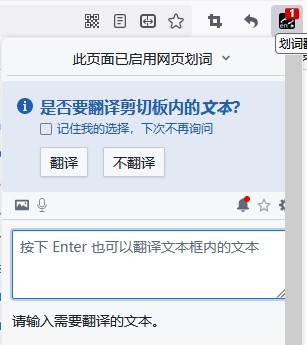
An extension can include many HTML pages, such as popup windows and options pages. Using the Immersive Translate extension as an example, left-clicking opens the popup window:
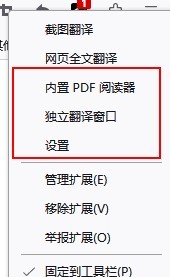
Right-clicking opens the entry to the additionally configured options page:
Based on the above requirements, the extension we need to develop is actually quite simple, with two main features:
- Edit the hosts list through the popup
- Proxy hosts through Chrome APIs
No page content modification or background services are needed. Therefore, we don't need service worker or content scripts. We mainly use the popup and other pages functionality. So the initial manifest for our host extension looks like this:
{
  "manifest_version": 3,
  "name": "Host Manager",
  "description": "A Simple Host Tool",
  "minimum_chrome_version": "24",
  "version": "0.0.1",
  "icons": {
    "16": "icons/logo-16.png",
    "48": "icons/logo-48.png",
    "128": "icons/logo-128.png"
  },
  // Controls icon click behavior
  "action": {
    "default_icon": "icons/logo-16.png",
    "default_title": "Host Manager",
    "default_popup": "index.html"
  },
  // Extension permissions
  "permissions": ["proxy"]
}
Development Approach
Since page development is involved, modern web development should naturally use a framework for future extensibility. Using vite@4.2.0 and vue@3.2.47 as an example, the project structure (excluding scaffolding files) should look like this:
// source
├─dist
├─public
│  ├─icons
│  └─manifest.json
└─src
    ├─assets
    ├─components
    ├─hooks
    ├─store
    ├─test
    ├─utils
    ├─App.vue
    ├─main.ts
    └─style.css
Write popup files in the src directory. After build, the compiled output and public files will be moved to the dist directory, which then serves as the extension source files for debugging.
├─index.html
├─manifest.json
├─assets
│   ├─index-022763e2.css
│   └─index-64e73436.js
└─images
    ├─logo-128.png
    ├─logo-48.png
    ├─logo-16.png
    └─logo.png
Extension Workflow
We'll skip the specific page development details. The only thing worth noting is that we want the extension to remember the user's host information rather than requiring re-entry every time the browser opens. Therefore, data management needs to use localStorage for persistence. Of course, with @vueuse/core and pinia, this can all be handled automatically.
The core of the entire extension lies in the proxy configuration. According to the official documentation, we first need to add the proxy permission field to permissions.
Regarding proxy, Chrome provides several modes:
- direct
- auto_detect
- pac_script
- fixed_servers
- system
direct makes direct requests, system uses the system proxy, and fixed_servers is mainly used to forward all requests to a fixed address — this feature is commonly used as part of proxy extensions like SwitchyOmega. auto_detect also resolves through PAC scripts, but the script must be 'downloadable at http://wpad/wpad.dat' and allows no other configuration.
Therefore, we chose the pac_script mode. This mode allows us to customize scripts from data literals or URLs, making it the most suitable mode for implementing our custom host functionality.
At this point, the entire business workflow is complete:
- Popup page where users input custom hosts
- Parse hosts into recognizable pacScript
- Use Chrome API for resolution
// Official example
const config = {
  mode: 'pac_script',
  pacScript: {
    data:
      'function FindProxyForURL(url, host) {\n' +
      "  if (host == 'foobar.com')\n" +
      "    return 'PROXY blackhole:80';\n" +
      "  return 'DIRECT';\n" +
      '}'
  }
};
chrome.proxy.settings.set({ value: config, scope: 'regular' }, function () {});
PAC
If the core of the extension is the proxy configuration, then the core of that configuration is pacScript generation. So what exactly is PAC? PAC stands for Proxy Auto Config — literally, "proxy auto-configuration."
According to MDN's definition:
A Proxy Auto-Configuration (PAC) file is a JavaScript function that determines whether web browser requests (HTTP, HTTPS, and FTP) go directly to the destination or are forwarded to a web proxy server.
And according to Wikipedia:
A proxy auto-config (PAC) file defines how web browsers and other user agents can automatically choose the appropriate proxy server (access method) for fetching a given URL
// Function in a PAC file
function FindProxyForURL(url, host) {
  // code
}
This function receives two parameters: url & host. Two important notes:
- When the request URL is
https, thepathandqueryin theURLwill be stripped. Behavior may vary across different browsers and user settings. Therefore, for a URL likehttps://test.com/url.html?type=add, the safest approach is to match theurlfield usingtest.comrather than a full match. hostis a field extracted from the URL. It is equivalent to the string between://and the first:or/in theURL. In other words, this field does not containportinformation.
The FindProxyForURL function in a PAC file can return a string that must match one of the following formats:
- DIRECT
- PROXY host:port
- SOCKS host:port
- HTTP: host:port
- HTTPS: host:port
- SOCKS4 host:port, SOCKS5 host:port
Where PROXY is a protocol-adaptive header.
A Simple Implementation
Let's revisit our original goal:
# Automatically switch between the following two addresses
# Staging
172.127.80.1 common-url.com
# Testing
172.127.230.16 common-url.com
A simple PAC function implementation:
// ipConfig.js
const preIp = '172.127.80.1:80';
const testIp = '172.127.230.16:80';
const getIpByEnv = (env) => (env === 'pre' ? preIp : testIp);

// setProxy.js
const env = 'pre';
function FindProxyForURL(url, host) {
  if (host === 'common-url.com') {
    return `PROXY ${getIpByEnv(env)}`;
  } else return 'SYSTEM';
}
This enables dynamic switching for the common-url.com address — just add a toggle related to the env variable on the popup page. Of course, this PAC still has several immature aspects:
- If
preIportestIpbecomes invalid, the request will fail directly. It's better to add a fallback option likeSYSTEM. - For regular page
hostsettings, the application-layer protocols involved are typicallyhttpandhttps. The current method proxies all possible application-layer protocols, includingftp. - For
localhost, going throughSYSTEMproxy will make it inaccessible.
Let's improve the method:
// setProxy.js
const env = 'pre';
function FindProxyForURL(url, host) {
  if (shExpMatch(url, 'http:*') || shExpMatch(url, 'https:*')) {
    // Only proxy http and https
    if (host === 'localhost') {
      // Special handling for localhost
      return 'DIRECT';
    } else {
      // Add fallback
      return `PROXY ${getIpByEnv(env)}; SYSTEM`;
    }
  } else {
    return 'SYSTEM';
  }
}
Predefined Functions
The shExpMatch(str, shexp) used in the FindProxyForURL method is a predefined function. Its usage can be found on MDN, used to determine whether a str matches a given shexp shell expression.
With predefined functions, we can implement more configuration options. For example, isPlainHostName(host) determines whether a host is a non-domain-style hostname:
isPlainHostName('www.mozilla.org'); // false
isPlainHostName('www'); // true
Another example: in practice, we can use the predefined function localHostOrDomainIs() to match all sub domain addresses:
localHostOrDomainIs('www.mozilla.org', 'www.mozilla.org'); // true (exact match)
localHostOrDomainIs('www', 'www.mozilla.org'); // true (hostname match, domain not specified)
localHostOrDomainIs('www.google.com', 'www.mozilla.org'); // false (domain name mismatch)
localHostOrDomainIs('home.mozilla.org', 'www.mozilla.org'); // false (hostname mismatch)
Custom URL Handler Functions
Although FindProxyForURL provides many commonly used predefined functions, we can still extend the capabilities of a PAC file through custom functions.
function isNumericIP(host) {
  // A regular expression that matches a valid IP address in dotted-decimal notation
  var ipRegex = new RegExp(
    '^\\d{1,3}\\.\\d{1,3}\\.\\d{1,3}\\.\\d{1,3}',
    'g'
  );
  // Test the host against the regular expression and return the result
  return ipRegex.test(host);
}

function FindProxyForURL(url, host) {
  if (isNumericIP(host)) {
    return 'DIRECT';
  }
  // --snip--
}
You can use the PAC Online Testing Tool to test whether your PAC file works correctly.
HTTPS
The initial development of the extension is basically complete at this point. Let's review the proxy workflow with the technologies used:
- Develop the
popuppage usingvue+tailwindcssto edithostscontent - Use
pinia+vueusefor real-time updates and persistence ofhosts - After parsing
hosts, generate the correspondingFindProxyForURLfunction and call theChrome APIto update the proxy
In theory, since FindProxyForURL already proxies https, entering any address with a matching domain should successfully proxy. However, in practice, https cannot be correctly proxied. 
The reason lies in the nature of https itself and the principles of PAC.
Recall the definition of PAC — the browser essentially forwards addresses through a proxy.
Suppose we configure a local proxy:
SOCK5 127.0.0.1:7890For any request, the browser forwards it to 127.0.0.1:7890, and then the 7890 server performs a secondary forward to obtain the response.
For the following host:
192.0.200.1 test.comThe parsed PAC Rule would be PROXY 192.0.200.1. When requesting http://test.com, it gets proxied to http://192.0.200.1, and the forwarding server http://192.0.200.1 directly returns the response without secondary forwarding, achieving an effect similar to DNS resolution.
However, HTTPS is fundamentally designed to prevent proxying. Because the motivation behind HTTP over TLS is to prevent Man-in-the-middle attacks and protect the integrity and privacy of exchanged data.
Two small questions may arise here:
- Why can system-level HTTPS be proxied through HTTP? For example, some proxy tools use commands like
set http_proxy=http://127.0.0.1:7890 & set https_proxy=http://127.0.0.1:7890 - Why can
SOCKSproxyhttpsin browsers? These questions still need further research.
Based on our analysis, forwarding https://test.com to http://192.0.200.1 via PAC Rules in the browser is itself a "man-in-the-middle" behavior. Therefore, forwarding https to an https or http server proxy will inevitably fail.
This is why system-level projects like SwitchHosts, whose core implementation setSystemHosts.ts directly writes to the system-level hosts file, don't have this problem.
System-level software like SwitchHosts directly modifies the hosts file, truly changing the system's DNS resolution. Browser extensions, on the other hand, are essentially proxy request interceptions — the system's DNS remains unchanged.
Solution Ideas
- First convert
httpsrequests tohttprequests, then go through the proxy.
- v2 solution: use the webRequest API for blocking requests and synchronous modification
- v3 introduces declarativeNetRequest for blocking and modifying network requests with specific declarative rules. Note that for
host-level redirects, you need to additionally requestdeclarativeNetRequestWithHostAccesspermission inmanifest.json
chrome.webRequest.onBeforeRequest.addListener(
  function (details) {
    return { redirectUrl: details.url.replace('https', 'http') };
  },
  {
    urls: domains.map(function (domain) {
      const url = 'https://' + domain + base + '/*';
      return url;
    })
  },
  ['blocking']
);
// or
chrome.declarativeNetRequest.updateDynamicRules(
  {
    addRules: [
      {
        // change the scheme of the URLs which match the domains of hosts
        id: 1,
        priority: 1,
        action: {
          type: chrome.declarativeNetRequest.RuleActionType.REDIRECT,
          redirect: {
            transform: { scheme: 'http' }
          }
        },
        condition: {
          urlFilter: `||${domain}`
        }
      }
    ],
    removeRuleIds: lastRuleIds
  },
  () => {
    lastRuleIds = newRules.map((info) => info.id);
  }
);
This solution handles most cases, but there are some edge cases it cannot resolve:
iframe redirect errors
Consider a page
https://www.test.comwith an internaliframehttps://a.test.com. For both pages:- Both have
hostconfigured - Both
https://www.test.comandhttps://a.test.comdepend on cookies under thetest.comdomain
When opening the page, the
iframerequest will error. If the cookie is used for authentication, the page will directly show an authentication failure error code.Reason: The iframe doesn't correctly carry cookies after redirection. This is fundamentally related to HTTP Cookie policies and the browser's cookie mechanism, causing the browser to block set-cookie in the iframe's navigation link, leaving the iframe without cookies. If the request has
SameSite=StrictorSameSite=Lax(Chrome defaults toSameSite=Laxif not set), the browser will block non-top-level set-cookie requests, resulting in requests without cookies. This works fine with https requests, but errors occur after redirecting to http.This Set-Cookie header didn't specify a 'SameSite" attribute and was defaulted to "SameSite=Lax," and was blocked becaus a cross-site response which was not the response to a top-level navigation. The Set-Cookie had to have been set with "Sam to enable cross-site usage.
- Both have
Infinite redirects
Certain pages with
Upgrade-Insecure-Requests: 1set may cause infinite redirect loops. When the server returns aLocation, thehttprequest gets redirected to anhttpsLocation, and the newhttpsaddress gets redirected back tohttpby the extension, causing an infinite loop.Note: This issue doesn't occur in incognito mode. The
Upgrade-Insecure-Requests: 1request header is still present, suggesting this is internal browser behavior.
Final Product
After clarifying the workflow and technical points, you can search directly on GitHub — such extensions must already exist. Surprisingly though, there aren't many.
For example, two relatively representative (higher star count) extensions are host-switch-plus and awesome-host-manager.
host-switch-plus has already been delisted from the Chrome WebStore. While awesome-host-manager can still be installed from the store, its last feature update was four years ago. Both extensions use relatively outdated technology, are difficult to debug locally, and their manifest versions are still at version 2.
So I started a new project from scratch: HostsWitch, built with React + MUI + Jotai.
Development Pain Points
During initial development, I only researched the architecture. The development workflow was to build static pages directly, then update the browser extension through build + reload for debugging. Later I discovered there were already existing scaffolding tools for this... such as vitesse-webext.